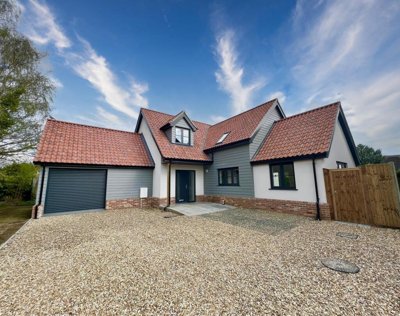
Browse 1 rental home to rent in Norton from local letting agents.
The larger property sector typically features multiple bathrooms, substantial reception space, and private gardens or off-street parking. Four bedroom houses in Norton span detached, semi-detached, and occasionally terraced configurations, with styles ranging from period properties to modern executive homes.
Norton’s property market reflects the village itself, rural Suffolk, limited stock and steady demand all pulling in the same direction. Recent sales data puts detached homes at an average of £360,000 within two miles of the village centre. Semi-detached properties sit at around £217,500, terraced homes at approximately £199,542, and flats are still relatively thin on the ground at £125,667, which says a lot about the houses-and-cottages make-up of the area.
New build activity has been noticeable in Norton over recent years, with a string of developments adding quality homes to the local market. Packway Gardens by LDA Developments offers high-specification, energy-efficient homes with features such as underfloor heating, set on the edge of the village with good links to Bury St Edmunds. Over at Sweet Hill Drive, executive homes include generous five-bedroom houses and bungalows with double garages and panoramic field views from £700,000, while Phase 1 of luxury bespoke homes brings four-bedroom, three-bathroom detached properties exceeding 2,720 square feet on plots approaching half an acre, with guide prices from £1,100,000 and completion anticipated for Summer 2026. It all points to continued investment in Norton and a useful spread of modern rental opportunities.

Norton has that classic Suffolk village feel, where agricultural heritage still sits comfortably alongside rural living today. Within Mid Suffolk District, 47% of properties are detached, compared with 22.9% across England, so the village naturally leans towards spacious homes with gardens and grounds. The population of 1,107 residents across around 200 households gives the place a proper community scale, where people know one another and village events still matter. It is a small settlement, but not cut off.
Architecturally, Norton shows off Suffolk’s building traditions through flint, red brick, timber framing and lime renders, all of which shape the village streetscape. The Church of St Andrew is a clear focal point, with its flint facings and decorative flushwork showing the skill of medieval East Anglian builders. Across the village, homes range from Georgian farmhouses to Victorian cottages, and many are listed buildings because of their historical value. A notable 69.5% of Norton households relied on oil-fired heating in the most recent census data, which fits the rural setting and the fact that mains gas is not widespread. The Norton Dog gives the village a pub and restaurant to gather in, while the primary school serves young families from the surrounding countryside.

At the village end of education, Norton Church of England Primary School serves children from reception through to Year 6. It sits within the village itself, so families avoid long daily journeys for primary school runs, and its Church of England foundation reflects the religious heritage that has shaped Norton for centuries. For secondary education, pupils usually head to Bury St Edmunds, where several secondary schools and sixth-form colleges open up a wider choice of academic and vocational routes. Travel remains manageable, with school transport links connecting the village to schools in the nearby towns.
Mid Suffolk District has grown by 6.2% since 2011, reaching 102,700 residents in 2021, and that steady rise has fed through into education investment across the area. Families renting in Norton can read Ofsted reports for a clearer picture of school performance, with the village primary school acting as the first educational stop for younger children. If independent schooling is preferred, several well-regarded schools sit within reasonable driving distance of the village. Having a good primary school on the doorstep matters here, because it cuts out the cost and strain of daily trips into distant towns while children stay rooted in a close-knit community.

From Norton, the balance between rural calm and everyday practicality is one of the main draws. Bury St Edmunds, Suffolk’s historic market town, is only a short drive away, and its rail links reach Cambridge in approximately 40 minutes and London Liverpool Street in around 90 minutes on CrossCountry and Greater Anglia services. That makes the village a workable base for commuters heading to Cambridge or Ipswich, especially when housing costs sit well below city levels. The A14 also runs nearby, tying the area into the wider motorway network and opening up travel towards Norwich, Felixstowe and the Midlands beyond.
Bus services link Norton with surrounding villages and market towns, giving people without a car a practical way to get around. There is also a village garage and service station, and parking is generally generous, so car ownership is straightforward. Cyclists benefit from the quiet Suffolk lanes, although journeys to larger towns need a bit of planning and time. For flights, London Stansted Airport is within approximately an hour’s drive, while Norwich and Cambridge airports add domestic options, which is handy for frequent travellers and anyone with international work commitments.

Before viewing homes in Norton, we would suggest getting a rental budget agreed in principle with a lender. It shows landlords and estate agents that the numbers are already in place, which helps in a market where good rentals can draw several applications.
We would also spend time walking the village and the surrounding lanes to get a feel for everyday life. Commute times, school access, local shops and services, and the character of each part of the village all play their part.
Property portals and local estate agents active in the Norton market are the next stop. From there, we would book viewings for homes that fit the brief, then look closely at the condition, garden access, parking and whether the property really suits the household.
Once the right place turns up, it is best to move quickly with the application. We would gather the usual paperwork, including proof of identity, income verification, employment references and any previous landlord references that are available.
The chosen referencing service will then check financial status and rental history. If everything comes back satisfactorily, the tenancy agreement is signed and the required deposit is paid, usually five weeks' rent for properties rented at £50,000 per year or less.
After that, we arrange the inventory check, switch the utilities into the new tenant’s name and coordinate the move-in date with the landlord or letting agent. We would always take detailed photographs of the property condition too, just in case there is any dispute over the deposit at the end of the tenancy.
Renting in Norton calls for a bit of area-specific knowledge, because this rural Suffolk village works differently from an urban rental market. With 69.5% of households relying on oil-fired heating, we would check any system carefully, since oil brings different running costs and maintenance responsibilities from mains gas. Older Norton homes may also use clay lump, timber framing and flint brickwork, so a surveyor needs specialist understanding and a standard home report may not tell the full story. Properties of this age often need more upkeep and can feel very different from modern builds, which is why understanding construction and condition before committing to a tenancy matters.
Boulder clay geology across Mid Suffolk brings the risk of shrink-swell subsidence, especially where trees or large planting sit close to the foundations. Clay soils expand and contract as moisture levels change, and older buildings with shallow foundations or patchy repair can feel the effect. Flood risk also needs checking, particularly on low-lying ground or near watercourses, even if specific flood maps for Norton were not highlighted. Many homes here are listed buildings or sit in conservation areas, so tenants may find restrictions on alterations, decorations and changes they might otherwise expect to make.

Direct rental price data for Norton was not available in the research, but the average sold price in the village was £515,429 over the past year, with detached properties averaging £360,000 within two miles of the village centre. In practice, rental values usually track sale values, and similar rural Suffolk villages often fall somewhere between £900 and £1,800 per month depending on size, condition and specification. For the latest figures, property portals and local letting agents remain the most reliable place to look.
Mid Suffolk District Council is the local authority for Norton and sets council tax using valuation bands from A through H. Because many village homes are older and often carry historic character, properties can sit in a range of bands depending on their assessed value. Annual council tax schedules set out the exact charges for each band, and we would always check the band with the landlord or agent before a tenancy is agreed.
Norton Church of England Primary School serves the village directly, taking children from reception through Year 6 within the community. For secondary education, pupils usually travel to Bury St Edmunds, where several secondary schools and sixth-form colleges are available through school transport or day-to-day commuting. The primary school has been inspected by Ofsted, and parents should look at the latest performance data and reports before making any decisions for their children.
Local bus services give Norton a connection to Bury St Edmunds and the surrounding villages, which matters for residents without private cars. Bury St Edmunds railway station runs regular services to Cambridge, Ipswich and London Liverpool Street, with journey times of approximately 40 minutes to Cambridge and 90 minutes to London. Road access is strong too, thanks to the village’s position near the A14, which links the area to Cambridge, Ipswich, Norwich and the wider motorway network.
For renters looking for countryside living within reach of town, Norton offers a strong mix of history, community and everyday practicality. The village has a population of approximately 1,107 residents across 200 households, so it stays intimate without feeling empty. Walking and cycling routes run through the Suffolk countryside, and the essentials are all here, including a primary school, a pub and a garage. Bury St Edmunds is close enough for shopping, healthcare and entertainment, which makes Norton a sensible choice for families and professionals who want rural calm without giving up convenience.
Under the current tenant fee rules, deposits for properties rented at £50,000 per year or less are capped at five weeks' rent. Holding deposits are capped at one week's rent. In practice, you may also face referencing fees for yourself and any guarantors, a deposit that is returnable at the end of the tenancy minus deductions for damage or unpaid rent, and possibly an early termination charge if you need to leave early. We always advise asking for a full breakdown of costs from the landlord or letting agent before committing to a property, because clear pricing protects both sides throughout the tenancy.
From 4.5%
Get a rental budget agreed in principle before you start searching for homes in Norton.
From £75
Referencing support that helps rental applications move along.
From £350
Expert survey for your new rental property
From £75
Energy performance certificate for your rental property
Understanding the money side of renting in Norton makes budgeting much easier and helps avoid unwanted surprises during the search. The deposit, capped at five weeks' rent for properties with annual rents up to £50,000, gives the landlord protection against unpaid rent or damage. It should be returned in full at the end of the tenancy, minus any legitimate deductions for damage beyond fair wear and tear or unpaid rent, so careful check-in records and photographs are well worth having.
Other costs to plan for include tenant referencing fees, usually between £75 and £200 depending on the provider and the number of applicants, which cover credit checks, employment verification and previous landlord references. Holding deposits, capped at one week's rent, hold the property while referencing and paperwork are completed, but they are not refundable if you withdraw without a good reason. Moving costs, whether that means van hire or a professional removals firm, should sit alongside any immediate purchases for an unfurnished or part-furnished home. Energy performance certificates are required for all rental properties, and although landlords usually arrange them, the rating is still useful because it helps us judge heating costs, which matters in Norton where many homes rely on oil-fired heating rather than mains gas.
Properties to Rent In London

Properties to Rent In Plymouth

Properties to Rent In Liverpool

Properties to Rent In Glasgow

Properties to Rent In Sheffield

Properties to Rent In Edinburgh

Properties to Rent In Coventry

Properties to Rent In Bradford

Properties to Rent In Manchester

Properties to Rent In Birmingham

Properties to Rent In Bristol

Properties to Rent In Oxford

Properties to Rent In Leicester

Properties to Rent In Newcastle

Properties to Rent In Leeds

Properties to Rent In Southampton

Properties to Rent In Cardiff

Properties to Rent In Nottingham

Properties to Rent In Norwich

Properties to Rent In Brighton

Properties to Rent In Derby

Properties to Rent In Portsmouth

Properties to Rent In Northampton

Properties to Rent In Milton Keynes

Properties to Rent In Bournemouth

Properties to Rent In Bolton

Properties to Rent In Swansea

Properties to Rent In Swindon

Properties to Rent In Peterborough

Properties to Rent In Wolverhampton

Enter your details to see if this property is within your budget.
Loans, cards, car finance
Estimated property budget
Borrowing + deposit
You could borrow between
Typical borrowing
Monthly repayment
Est. at 4.5%
Loan-to-value
This is an estimate only. Your actual budget may vary depending on interest rates, credit history, and personal circumstances. For an accurate affordability assessment, speak to one of our free mortgage advisors.
This calculator provides estimates for illustrative purposes only and does not constitute financial advice. Your home may be repossessed if you do not keep up repayments on your mortgage. Estimates based on 4.5% interest rate, repayment mortgage. Actual rates depend on your circumstances.
Homemove is a trading name of HM Haus Group Ltd (Company No. 13873779, registered in England & Wales). Homemove Mortgages Ltd (Company No. 15947693) is an Appointed Representative of TMG Direct Limited, trading as TMG Mortgage Network, which is authorised and regulated by the Financial Conduct Authority (FRN 786245). Homemove Mortgages Ltd is entered on the FCA Register as an Appointed Representative (FRN 1022429). You can check registrations at NewRegister or by calling 0800 111 6768.

We use cookies to show you personalised content and improve your experience of our website. Find out more in our Privacy policy and Cookie policy.