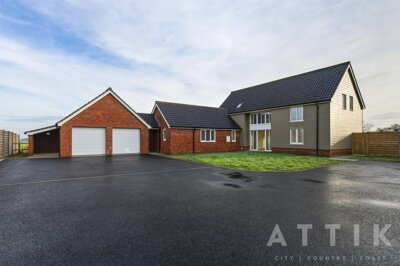
Browse 1 home new builds in Dickleburgh and Rushall from local developer agents.
Dickleburgh and Rushall's property market has held up well, and the numbers still point to steady demand. The average house price sits at £362,000, while detached homes average £356,500 and semi-detached homes £246,250. That gap reflects what sells here, bigger family houses in a semi-rural spot where inside space and a bit of garden matter. In IP21 4, which covers the village, there were 150 property transactions over the past year, and homes traded between £2,560 and £3,690 per square metre. Half of all sales in that postcode fell inside that bracket, which gives buyers a useful yardstick.
Year on year, prices in Dickleburgh are up 13%, a lift that speaks to the pull of village life in South Norfolk. Across the wider area, around 404 properties have changed hands over the past decade, so turnover has remained steady enough to give buyers choice. Merlewood is sitting 18% above last year, although it is still 17% below the 2022 peak of £349,333. Dickleburgh Moor has been steadier, with values over the past year sitting just 1% below the 2017 peak of £572,333.
For buyers narrowing down where to live, Merlewood carries the premium feel, while Dickleburgh Moor tends to suit those after larger detached homes and stronger values. IP21 4 offers the wider context across property types and locations. Semi-detached homes are the most affordable entry point at around £246,250, and detached houses still look good value beside similar homes in larger towns. home.co.uk brings together listings from every major estate agent active in Dickleburgh and Rushall, so we can see what is on the market right now.

Dickleburgh and Rushall is a civil parish in South Norfolk that captures the Norfolk village way of life neatly. Life here still revolves around the parish church, the local pub, and a web of public footpaths running through the surrounding farmland. Residents get the calm of the countryside without losing the services needed for day-to-day living. The two names matter too, Dickleburgh and Rushall forming one administrative unit that has kept its own identity through centuries of change.
The Norfolk countryside around the village gives plenty of scope for time outdoors. Arable fields, winding lanes and a rich spread of wildlife make it a draw for walkers and nature fans throughout the year. Local footpaths link the village with nearby communities, so walks to Diss or Scole are realistic for those who like to explore on foot. The Norfolk Broads are within reasonable driving distance as well, with boating, birdwatching and coastal walks along the eastern edge of the county all on the list.
Most daily errands take residents to Diss, around three miles away, where the practical side of village life is easy to manage. There are supermarkets, independent shops, healthcare facilities and a railway station with services to Norwich and London Liverpool Street. That close access means Dickleburgh and Rushall keeps its village feel without the isolation that can affect more remote places. Through the year, community events, from summer fetes to Christmas celebrations, pull people together and keep the neighbourly atmosphere going.
South Norfolk gives the area a useful balance of rural calm and easy reach. Residents get the quiet of village life, yet can still get to Norwich for work, shopping in the county city and cultural attractions across East Anglia without much fuss. The A140 corridor through nearby Scole links the village with Norwich and Ipswich, so driving is straightforward for commuters and for those heading out further afield.

Schools for families moving to Dickleburgh and Rushall are centred mainly on Diss. Diss Primary School serves the wider area and is known for solid academic standards and a nurturing setting. The catchment includes the village, so it is the obvious choice for younger children. There are also other primary schools in surrounding villages, giving some flexibility depending on admissions and individual circumstances.
Secondary pupils go to Diss High School, which provides a broad curriculum for students aged 11 through 16. The school has seen improvements in recent years and continues to serve pupils from the surrounding rural area. Sixth form provision is also available in Diss, with further education routes that lead towards university or vocational study. Parents should always check the latest catchment boundaries and admissions policies with Norfolk County Council, because these can change and may affect which schools serve particular addresses.
Independent education is available too, with Norfolk offering several well-regarded private schools within a sensible commute. Norwich and places further afield have boarding and day options, though they come with a significant commitment in time and money. For younger children, nurseries and preschool provision is available locally in both Dickleburgh and Diss. Put together, the primary and secondary choices make Dickleburgh and Rushall a practical base for families at every stage of schooling.
Because Diss is so close, school transport is already well established for daily journeys to primary and secondary schools. Many families find the drive takes 15-20 minutes by car, and school bus services give another option for those who would rather not drive. The result is that children can reach decent schools without the family needing to move to a larger town, so village life can carry on through the school years.

Rail links are anchored by nearby Diss, which opens the national network. From Diss railway station, Norwich is around 20 minutes away and London Liverpool Street about 90 minutes by direct train. That makes the village appealing to people commuting to the capital or to Norwich while still living in the countryside. Parking at the station helps too, so the drive-train combination works for anyone without a daily commute.
By road, the A140 runs through nearby Scole and links north to Norwich and south to Ipswich. The Norfolk road network has improved in recent years, which has cut journey times to major employment centres. For Norwich-based workers, the drive usually takes 35-40 minutes, traffic depending. The A14 is also within reach for routes to Cambridge and the motorway network, widening the options for longer commutes. Bus services do run between local villages and Diss, though they are less frequent than in urban areas.
Cycling is a popular way to get about here, helped by Norfolk's relatively flat landscape. Quiet lanes and dedicated routes make two wheels practical for shorter trips. The Sustrans National Cycle Network passes through the region as well, giving traffic-free stretches for leisure rides and some commuter journeys. For flights, Norwich International Airport has domestic and European connections, while London Stansted and London Luton are within reasonable driving distance for international travel. Put simply, Dickleburgh and Rushall suits flexible workers, Norwich commuters and people who travel to London now and then.
For anyone heading to London, Diss station is a useful compromise between village living and capital access. The 90-minute trip to Liverpool Street stacks up well against many suburban spots nearer London, yet the houses here are considerably cheaper and the pace of life is different. Plenty of residents work from home for part of the week and use the train only when needed, which keeps costs down and trims the environmental hit while still leaving careers in the city within reach.

Before we start viewing, we usually advise buyers to get a mortgage agreement in principle from a lender. It shows estate agents and sellers that the finances are in place, and it gives a clear idea of the real budget. In Dickleburgh and Rushall, where detached homes average £356,500, that borrowing limit matters. Brokers who know Norfolk property can sometimes find better rates than high street lenders on village homes.
Using our platform, buyers can compare recent sold prices in Dickleburgh and Rushall against similar homes. homedata.co.uk shows prices up 13% year on year and 34.3% over twelve months, so reading the market carefully matters. It also helps to keep the gap in mind between detached homes at £356,500 and semi-detached homes at £246,250 when shaping an offer. We also show historical movement in places such as Merlewood and Dickleburgh Moor.
We can also point buyers towards agents listing homes in Dickleburgh and Rushall, which makes arranging viewings much simpler. home.co.uk gathers those listings together, so comparing options across multiple agents is straightforward. Seeing properties in person still matters, though, for judging condition, setting and the feel of the neighbourhood. Age and construction type are worth a close look too, because traditional Norfolk buildings often need different maintenance from modern homes.
Once an offer is accepted, we recommend booking a RICS Level 2 Survey (Homebuyer Report) before moving forward. This inspection picks up structural issues, damp, roofing faults and other defects that are common in Norfolk properties. With the village mix including older homes and the possibility of period cottages, a professional survey is there to protect the purchase. We work with local surveyors who understand the building methods used in South Norfolk.
For the legal side, choose a solicitor with Norfolk property experience. They handle searches, contracts and the transfer of funds. In the IP21 4 postcode sector, local solicitors will already know the specific requirements of South Norfolk Council. Environmental searches matter in rural Norfolk too, as they can pick up historical land uses that may affect a property.
When all searches come back clean and the finance is confirmed, contracts are exchanged and the deposit is paid. Completion usually follows within weeks, after which the keys are handed over and ownership of the new Dickleburgh and Rushall home begins. We can also point buyers towards local utility providers and services, which helps the move go more smoothly.
Buying in a Norfolk village brings a few area-specific points into play. Around Dickleburgh and Rushall, properties come from different eras, and traditional Norfolk buildings with brick and flint construction may need specialist maintenance. Knowing the age and build of a home matters when planning repairs and improvements later on. Our listings show property age where it is available, and we always back that up with survey advice before a purchase goes ahead.
Flood risk deserves a proper check on any Norfolk purchase, given the county's waterways and its connection to the Broads. We did not find specific flood risk data for Dickleburgh and Rushall in our research, so the government flood risk maps and the searches the solicitor orders should be checked carefully. Homes near water features or in lower-lying spots deserve particular scrutiny. A RICS Level 2 Survey will show signs of damp or water damage that may point to historical flooding, and environmental searches should also look for old mining activity that could affect ground stability.
Energy efficiency varies a lot across Norfolk's housing stock, and older properties are especially likely to bring higher heating bills. An EPC assessment should be part of due diligence, with any improvement costs built into the offer. Some homes in the village may also fall under conservation controls, which can restrict permitted development rights. South Norfolk Council should always be checked for planning constraints, because they can shape both the purchase and any future renovation plans.
Private drainage is another common rural detail, with septic tanks or treatment plants needing regular maintenance and, at times, upgrades to meet current regulations. Our conveyancing partners include drainage searches as standard, but buyers should also inspect the septic tank location during a viewing. Shared drainage needs clear legal agreements. In the excitement of finding the right home, these practical points are easy to miss, yet they can become expensive if they are not dealt with before purchase.

As of February 2026, the average house price in Dickleburgh is approximately £362,000, according to homedata.co.uk current market data. Prices have risen by 13% over the past year, with sold prices up 34.3% over the previous twelve months. Detached homes average £356,500, while semi-detached homes sit at around £246,250. In IP21 4, there were 150 transactions over the past year, and properties sold between £2,560 and £3,690 per square metre.
For council tax, properties in Dickleburgh and Rushall fall under South Norfolk Council. Bands run from A through to H, depending on the property's assessed value. Most family houses in the village sit in bands B through D. Check the property details or speak to South Norfolk Council for the exact band and annual charge before buying.
Diss Primary School serves the wider catchment, including Dickleburgh and Rushall, for primary education. Diss High School takes pupils aged 11-16 at secondary level. Both schools are part of the local education picture and are usually reached by school transport in 15-20 minutes from the village. Families interested in independent schooling may want to look at private schools in Norwich and the surrounding area. Current catchment boundaries should always be checked with Norfolk County Council, since admissions policies can affect which schools cover a specific address.
Transport links are built around Diss, about three miles away, where Diss railway station offers regular trains to Norwich in 20 minutes and direct services to London Liverpool Street in 90 minutes. Bus routes do run between local villages, but they are sparse compared with urban services, so car ownership is close to essential for everyday life. The A140 through nearby Scole gives road access to Norwich and Ipswich. For commuters, the rail line to London keeps Dickleburgh and Rushall in play for capital work while village life remains intact.
Dickleburgh and Rushall's market has been performing strongly, with prices up 13% year on year and 34.3% over twelve months. Over the past ten years, around 404 properties have sold in the wider Dickleburgh area, which points to healthy activity. Proximity to Diss and the links to Norwich and London suggest demand should remain. Even so, every purchase needs a hard look at personal finances, the time horizon and local conditions before an offer goes in.
Stamp Duty Land Tax (SDLT) in 2024-25 is charged at 0% on the first £250,000 of property value, 5% on the portion from £250,001 to £925,000, 10% from £925,001 to £1.5 million, and 12% above £1.5 million. On a typical Dickleburgh home at £362,000, SDLT comes to £5,600. First-time buyers get relief on the first £425,000, bringing SDLT down to 5% on the £0 to £625,000 portion only. The solicitor will work out the exact amount due from the circumstances and purchase price.
From 3.94%
Expert mortgage advice for Dickleburgh and Rushall buyers
From £499
Specialist conveyancing solicitors for Norfolk properties
From £350
Professional surveys matter for all property types in Dickleburgh and Rushall.
From £60
Energy performance certificates for property sales
Getting the full cost picture is vital when buying in Dickleburgh and Rushall, because the purchase price is only the start. Stamp Duty Land Tax applies to all purchases above £250,000, with 5% charged on the portion between £250,001 and £925,000. On a typical village home costing £362,000, that means a SDLT bill of £5,600. First-time buyers receive relief, paying 0% on the first £425,000 and 5% on the portion up to £625,000, which can save around £1,800 compared with existing owner-occupiers.
Conveyancing fees usually begin at around £499 for a straightforward purchase, although extra complexity can push the cost higher. The solicitor will deal with searches such as South Norfolk Council local authority checks, environmental searches for contamination risk, and water and drainage enquiries. Those searches generally cost between £200 and £400, depending on the property and where it sits. For homes in IP21 4, the local authority processes the searches and they usually come back in two to four weeks.
Survey costs are often missed by first-time buyers, yet they are money well spent. A RICS Level 2 Survey (Homebuyer Report) starts from £350 and picks up structural issues, damp, roof problems and other defects that may not show during a viewing. Because Dickleburgh and Rushall includes older construction, that inspection has particular value. An EPC assessment costs from £60 and is a legal requirement for all sales. Mortgage arrangement fees typically sit between 0% and 1.5% of the loan amount.
Buyers should generally set aside an extra 3% to 5% of the purchase price for these costs, so on a £362,000 property that means roughly £10,860 to £18,100 on top of the deposit and mortgage. Moving costs, decorating and any repairs need a place in the budget too. We suggest getting quotes from several solicitors and surveyors so the Dickleburgh and Rushall purchase stays competitively priced.

Properties New Builds In London

Properties New Builds In Plymouth

Properties New Builds In Liverpool

Properties New Builds In Glasgow

Properties New Builds In Sheffield

Properties New Builds In Edinburgh

Properties New Builds In Coventry

Properties New Builds In Bradford

Properties New Builds In Manchester

Properties New Builds In Birmingham

Properties New Builds In Bristol

Properties New Builds In Oxford

Properties New Builds In Leicester

Properties New Builds In Newcastle

Properties New Builds In Leeds

Properties New Builds In Southampton

Properties New Builds In Cardiff

Properties New Builds In Nottingham

Properties New Builds In Norwich

Properties New Builds In Brighton

Properties New Builds In Derby

Properties New Builds In Portsmouth

Properties New Builds In Northampton

Properties New Builds In Milton Keynes

Properties New Builds In Bournemouth

Properties New Builds In Bolton

Properties New Builds In Swansea

Properties New Builds In Swindon

Properties New Builds In Peterborough

Properties New Builds In Wolverhampton

Enter your details to see if this property is within your budget.
Loans, cards, car finance
Estimated property budget
Borrowing + deposit
You could borrow between
Typical borrowing
Monthly repayment
Est. at 4.5%
Loan-to-value
This is an estimate only. Your actual budget may vary depending on interest rates, credit history, and personal circumstances. For an accurate affordability assessment, speak to one of our free mortgage advisors.
This calculator provides estimates for illustrative purposes only and does not constitute financial advice. Your home may be repossessed if you do not keep up repayments on your mortgage. Estimates based on 4.5% interest rate, repayment mortgage. Actual rates depend on your circumstances.
Homemove is a trading name of HM Haus Group Ltd (Company No. 13873779, registered in England & Wales). Homemove Mortgages Ltd (Company No. 15947693) is an Appointed Representative of TMG Direct Limited, trading as TMG Mortgage Network, which is authorised and regulated by the Financial Conduct Authority (FRN 786245). Homemove Mortgages Ltd is entered on the FCA Register as an Appointed Representative (FRN 1022429). You can check registrations at NewRegister or by calling 0800 111 6768.

We use cookies to show you personalised content and improve your experience of our website. Find out more in our Privacy policy and Cookie policy.