Browse 2 homes for sale in Goudhurst, Tunbridge Wells from local estate agents.
The 2 bed flat sector typically includes two separate bedrooms, dedicated living areas, and bathroom facilities. Properties in Goudhurst span purpose-built blocks, converted period houses, and modern apartment complexes on various floors.
£205k
1
0
48
Source: home.co.uk
Showing 1 results for 2 Bedroom Flats for sale in Goudhurst, Tunbridge Wells. The median asking price is £205,000.
Source: home.co.uk
Flat
1 listings
Avg £205,000
Source: home.co.uk
Source: home.co.uk
Goudhurst's market has shifted quite a bit over the past year. Current listings put the overall average at about £806,820, and average sold price data also sits at £806,820, while other measures show an average price paid closer to £618,071 as of early 2026. That gap usually comes down to which property types have sold and when those deals completed during the year. After the 2023 peak of £752,066, values are now reported at around 35% below that level, which may suit buyers who sat out the last boom cycle.
Buyers in Goudhurst have a fairly broad spread of property types to choose from. Detached houses sit at the top end, averaging around £966,426, which reflects their larger plots and more rural settings. Semi-detached homes come in at approximately £618,071 and tend to appeal to families wanting more room than a cottage offers. Terraced homes start from around £459,000, giving both first-time buyers and downsizers a more reachable way into village living. Flats change hands less often here, but recent sales at approximately £246,667 show there is still a smaller, active part of the market for them.
New build supply in the TN17 postcode is still fairly scarce, and there are no major schemes currently under way in Goudhurst itself. For buyers set on a modern home, that often means looking instead towards nearby Tunbridge Wells or Cranbrook. Over the last decade, Goudhurst and neighbouring Lamberhurst have seen about 500 properties sold, according to Property Market Intel data, with more than 1,000 total transactions across the combined area. Semi-detached homes account for much of that activity, although the village also has notable pockets of appealing terraced cottages and larger detached houses with generous gardens.

Life here moves at the steadier pace you would expect in rural Kent, and Goudhurst has kept a close-knit feel that many larger places have lost. The Plain is still the centre of things, with its historic village green framed by period buildings in the local red brick and tile tradition. There is a traditional pub where people meet, and the parish church adds another long-established landmark to the street scene. Around that, independent shops, artisan producers and traditional craftspeople help keep the local economy lively, despite the village's modest size.
The High Weald around Goudhurst is a big part of the draw. Ancient woodland, rolling farmland and old hedgerows give the area real ecological value, and there is no shortage of public rights of way for walking or riding. The Weald Way and other routes cut through some of Kent's least spoiled countryside. Underfoot, the Wealden Clay and sandstone help shape the area's undulating landscape, and plenty of homes take in long views across the Weald. Cranbrook is close by for independent shops and its weekly market, while Lamberhurst adds useful day-to-day amenities such as a village shop and primary school.
An active parish council helps keep community life going in Goudhurst, putting on events through the year from summer fetes to Christmas gatherings for residents and the wider community. The village hall is well used too, hosting everything from yoga classes to theatrical productions. That matters in a rural setting. Families are often drawn here as much by the enduring sense of community as by the countryside itself, and the mix of village character, easy access to open land and reasonable reach to Tunbridge Wells gives the area obvious appeal for anyone wanting a quieter base without cutting ties to town facilities.

Families in Goudhurst have education options from the early years onwards. In the village itself, Goudhurst and Kilndown Church of England Primary School serves children from Reception to Year 6, drawing pupils from across the parish and nearby villages. Schools in this part of Kent often benefit from smaller class sizes than their urban counterparts, which can mean more individual attention. Outdoor learning is part of the attraction too, with the surrounding countryside lending itself naturally to that broader approach to primary education.
For secondary schooling, most families look beyond the village. Cranbrook School is a well-known option in nearby Cranbrook, taking pupils from age 11 through to sixth form and holding specialist status in the arts, alongside a strong academic and extracurricular reputation. Others consider Tunbridge Wells Girls' Grammar School or Tunbridge Wells Grammar School for Boys in the wider Tunbridge Wells area. School travel is part of the routine here, usually by bus or with parents driving, and the trip to Tunbridge Wells is typically around 20-30 minutes by car.
Private education is another route some families consider, with independent schools in the Tunbridge Wells area including The Schools at St. Dunstan's, Skinners' Kent Primary School, and Tunbridge Wells Grammars at both primary and secondary levels. Sixth form choices include school sixth forms as well as further education colleges, and many pupils then move on to universities across the UK. Anyone moving to Goudhurst for schooling reasons should check catchment areas carefully, because places can be competitive, especially at popular primary schools in the village and nearby parishes. Early registration is often sensible given the rural setting and the limited provision within Goudhurst itself.

Road links do most of the heavy lifting in Goudhurst. The village sits on the A262, which runs through the centre and links north to the A21 at Lamberhurst and south towards Hawkhurst. From there, the A21 gives the main route up to Tunbridge Wells and onwards to the M25, opening up London and the wider motorway network. By car, Tunbridge Wells is roughly 20 minutes away, while London is about one hour depending on traffic. In practice, most residents find car ownership essential because of the rural roads and the limited alternatives.
Public transport is available, but it is not extensive. Bus services call in the village and link Goudhurst with Tunbridge Wells, Cranbrook and Hawkhurst, though they are usually far less frequent than town routes, sometimes only two to three times daily on certain services. That makes them useful for set journeys such as school runs or occasional trips rather than everyday flexibility. Rail travel means heading to Tunbridge Wells or Staplehurst, with Staplehurst giving access to London Bridge and the southeast coast via the Marshlink line. Tunbridge Wells station adds services to London Bridge, London Charing Cross and a range of south coast destinations.
Cycling has picked up locally in recent years as more people use it for leisure and, where practical, commuting. The High Weald is not gentle terrain, and the hills around Goudhurst can be demanding for inexperienced riders, though the views often make up for it. Electric bikes have made a real difference, opening up those steeper routes to more residents. For London commuters, the usual pattern is still to drive to a station and continue by rail, and plenty of people choose Goudhurst precisely because it lets them combine rural living with London-based work during the week.

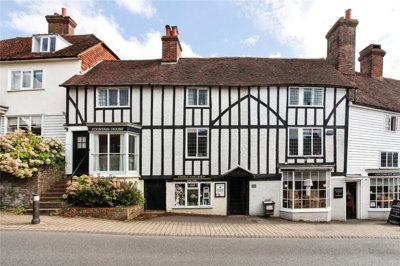
Much of Goudhurst's housing stock reflects centuries of local building practice. The Wealden style that developed across this part of Kent gives the village a recognisable character, especially in older farmhouses and cottages with timber frames, jettied upper floors and decorative tile-hung fronts. Before the mid-20th century, the usual build-up was structural timber framing with solid brick infill and clay tile roofs. Anyone buying a period house here needs to understand that construction, because it affects how the building performs and how it should be repaired.
Local geology has long dictated how homes in Goudhurst were built. Wealden Clay provided material for the red brick and roof tiles that still define much of the village, while Wealden sandstone was once quarried nearby for walls and garden details. In buildings dating from before Portland cement became widespread in the late 19th century, lime mortar is typically part of the original fabric, allowing walls to breathe and helping moisture move through as intended. Problems often begin when later repairs introduce cement-based materials, which can trap damp within the structure.
The geology of the High Weald also brings some very specific property issues. Heavy Wealden Clay is prone to marked volume change between wet and dry periods, the shrink-swell effect that can move the ground and affect foundations as well as underground drainage runs. Older houses, especially those built before modern regulations, may stand on relatively shallow traditional footings, and these are often more susceptible than the deeper foundations expected today. When we inspect homes in Goudhurst, our surveyors pay close attention to foundation performance, drainage behaviour and the condition of retaining walls where plots fall away.
Drainage deserves a close look in Goudhurst, partly because of the clay subsoil and partly because many systems are old. Soakaways on clay often perform badly, simply because the ground is too impermeable for water to disperse properly, which can lead to saturation and eventual failure. Where a property is off mains drainage, there will be a private sewage treatment arrangement that needs regular upkeep and must meet current environmental rules. Standards vary widely from one house to the next, and for any property over 20 years old we would usually treat a drainage test as a sensible step before purchase.
Period homes in Goudhurst tend to show a familiar set of defects, and it helps to know what those are before offering. Most properties in the village are more than 50 years old, and many date back to the 18th and 19th centuries, when traditional Wealden methods were widely used. They need to be judged differently from modern houses. A proper survey by a qualified professional is important, not just for peace of mind, but so buyers can plan realistically for repairs and avoid unpleasant surprises after completion.
Movement is one of the bigger risks to watch for in Goudhurst, especially on sloping plots or where foundations sit in clay. Subsidence and heave can show themselves through cracking in walls and chimneys, doors and windows that bind or no longer sit square, and visible displacement where extensions or outbuildings meet the main house. A Level 2 Survey can flag these problems and give an initial view on severity, but if the movement looks pronounced we may advise a more detailed Level 3 Structural Survey. Foundation repairs can be expensive, so specialist advice matters where damage is already apparent.
Damp is another recurring issue in the village's older housing stock. Solid walls without cavity insulation, decaying lime mortar, and original damp proof courses that have failed or were never particularly effective can all contribute. Traditional lime construction needs to breathe, and that balance is often upset by later cement render or impermeable paint, which holds moisture in and can accelerate decay in adjacent timber. During inspection we would want brickwork and mortar checked carefully, along with timber sills and sole plates, and we would also look at any existing damp proofing to see how well it is really performing. Ongoing maintenance is common where damp is significant, and remedial costs can mount up.
Timber decay comes up regularly in Goudhurst houses, affecting structural timbers as well as window and door frames and external joinery such as fascias and bargeboards. Age, exposure and spells of poor maintenance often create the right conditions for fungal attack to take hold. Signs can be quite straightforward, soft timber, discolouration, sawdust or wood chips around joints, or visible fungal growth. Our surveyors will test suspect areas and judge whether repair is possible or replacement is the safer option.
Roofs need proper scrutiny here. Many Goudhurst properties still have traditional clay tile coverings, and with age those can suffer from frost damage, knocks and general wear, leading to slipped tiles, missing sections, weakened ridge lines and failed mortar pointing. A good survey should also consider the state of the roof structure, sarking felt and lead flashings, not just the tiles themselves. If defects are widespread, buyers may be looking at partial repairs or a full re-roof, and that can have a major impact on the budget.
Goudhurst has a strong historic character, so heritage controls are a real part of buying here. A number of homes sit within or close to conservation areas, and others are listed for their architectural or historic significance. Conservation area designation is there to protect the village's appearance and character, which means tighter planning controls over works that might alter it. That can include visible changes to windows, doors, roof coverings and boundary treatments. Anyone planning future alterations should check a property's conservation area position before committing.
Listed buildings in Goudhurst range from smaller Grade II cottages to more prominent Grade II* buildings, including the parish church and historic inns. Listing brings statutory protection, not only for external appearance but often for important internal elements as well. Most outside works will need Listed Building Consent from Tunbridge Wells Borough Council, alongside any separate planning permission that may apply. Internal alterations can also need consent where original features such as fireplaces, staircases, panelling or structural timbers are involved. Houses with strong original detail often attract a premium, but they also come with added responsibilities.
Those conservation area and listed building constraints are worth looking into early. A Level 2 Survey can highlight the condition of older features and point to maintenance issues, but buyers should also check what changes have already been made and whether the correct consents were secured at the time. Proposed future works are best discussed with the planning team at Tunbridge Wells Borough Council before purchase, especially as permitted development rights may be reduced compared with non-designated homes. An early conversation with a conservation officer can clarify what may be possible, and what sort of cost and timescale might follow.

It pays to get a feel for the market before moving quickly. We suggest reviewing current listings on Homemove, spending time in the village at different points in the day, and speaking with local estate agents about stock levels and pricing patterns. Goudhurst has already seen sizeable corrections from the 2023 peak, which may create openings for decisive buyers. In practice, most sales are handled by agents based in Tunbridge Wells, and they can usually give the clearest picture of what is really happening on the ground.
Before viewings gather pace, we would line up mortgage finance. An agreement in principle shows how much can be borrowed and signals to sellers that a buyer is in a position to proceed. Brokers and lenders who know the Kent market can also talk through products suited to this price bracket, including specialist rural lending where land, outbuildings or unusual property features come into play.
Viewings matter more in a village like this than a listing ever can. We always advise seeing properties in person so condition, exact setting and distance from local amenities can be judged properly. Age, construction type and likely maintenance needs all deserve close attention, and a second visit at another time of day can reveal practical issues such as traffic, noise or parking pressure. With period homes in particular, it helps to arrive knowing the kinds of defects often found in traditional High Weald construction.
Once an offer is accepted, the next step is usually to book a Level 2 Survey. Our surveyors use that inspection to identify structural concerns, defects and any areas that may need work before a purchase goes ahead. In Goudhurst, older houses sometimes call for further investigation, and our team is used to the traditional Wealden construction seen throughout the village. The report then sets out the property's condition clearly, including urgent repairs that should not be ignored.
After that, we would appoint a solicitor to deal with the legal side of the purchase, from searches and contract work through to HM Land Registry registration. Conveyancers who regularly handle Kent transactions are often better placed to manage issues linked to period homes, conservation areas and rural titles. They will also order searches relevant to Tunbridge Wells borough and check any planning or Listed Building points that could affect the property.
Once searches are back in acceptable form and mortgage funding is in place, solicitors move on to exchange and fix a completion date. On completion day, the balance is transferred and the keys are released for the new Goudhurst home. It is wise to leave room in the budget for SDLT, legal fees, survey costs and any early repair work highlighted in the report.
Current listings data puts average house prices in Goudhurst at about £806,820. Other sources place the overall average slightly differently, though still around £806,820 to £806,820 depending on the method used and the period measured. Broken down by type, detached homes average £966,426, semi-detached properties about £618,071, and terraced houses from £459,000. Against the 2023 peak of £752,066, the market is now said to sit approximately 35% lower, which may have opened a window for buyers who missed the earlier upswing.
For council tax, Goudhurst comes under Tunbridge Wells Borough Council. Individual homes are placed into bands according to value, from Band A at the lower end through to Band H for the largest and highest-value properties. Before exchange, buyers should confirm the banding of any specific address, either through the Valuation Office Agency website or during conveyancing. Bills also include the parish council element, which in Goudhurst contributes towards local upkeep and community facilities.
Schooling is a major reason some families look at Goudhurst. Goudhurst and Kilndown Church of England Primary School serves the village from Reception to Year 6 and is generally well regarded for both pastoral support and academic progress. For secondary education, families often consider Cranbrook School or the grammar schools in Tunbridge Wells, with the latter requiring the Kent selection test to be passed. Independent schools in the Tunbridge Wells area widen the choice further. Catchment rules are worth checking carefully, as places can be tight in a rural area with limited local provision.
Compared with a town, Goudhurst has fairly limited public transport. Buses do link the village with Tunbridge Wells, Cranbrook and Hawkhurst, but frequencies are modest, often only two to three services a day on many routes. The nearest railway stations are Tunbridge Wells and Staplehurst, both offering routes towards London and the southeast coast. So while the A262 gives decent road access to surrounding centres and onward to the A21, daily life here still tends to rely on having a car.
From an investment point of view, Goudhurst has a few qualities that stand out. Rural Kent villages continue to attract demand, new build supply is limited, and the lifestyle appeal remains strong. Values have also corrected noticeably from recent highs, which may offer a better entry point than buyers would have found 18 months ago. That said, rural markets can move more slowly than urban ones and may show sharper price swings, so holding period, likely rental demand and exit strategy all need proper thought. Properties in conservation areas, or those with strong original detail, may prove more resilient simply because supply is constrained.
SDLT on a Goudhurst purchase depends on both the price paid and the buyer's status. For a standard purchase, the first £250,000 is charged at 0%, the portion from £250,001 to £925,000 at 5%, the slice from £925,001 to £1.5 million at 10%, and anything above that at 12%. First-time buyers get 0% on the first £425,000, then 5% from £425,001 to £625,000. With average values in Goudhurst around £806,820, many transactions will fall into the 5% bracket for the amount above £250,000. Buyers of additional properties, and non-UK residents, pay higher rates.
Period homes in Goudhurst need a careful eye before purchase. Many are built in the traditional Wealden style, with red brick, tile and sometimes timber framing, so common risks include roof defects, damp penetration, foundation movement and wear to original features. Clay tile roofs and timber-framed sections can both bring very specific maintenance demands. It is also important to confirm whether a property sits in a conservation area or carries listed status, as that shapes future alterations and permitted development rights. For that reason, we strongly recommend a thorough RICS Level 2 Survey on any older house here.
From £350
A detailed inspection of the property condition, identifying defects common in period properties
From 4.5% APR
Expert mortgage advice tailored to your circumstances
From £499
Legal services for your property purchase
From £80
Energy performance certificate for your property
Buying costs in Goudhurst go well beyond the asking price, so the numbers need setting out early. SDLT is usually the largest extra for buyers, applying to purchases above £250,000. On a typical Goudhurst price of £806,820, a standard buyer would pay 5% on £556,820, producing an SDLT bill of £27,841. A first-time buyer may pay less, with 0% up to £425,000 and 5% on the rest, which would reduce the charge to £19,091 on an £806,820 purchase. These figures should still be checked with a financial adviser or mortgage broker, because personal circumstances can alter the final liability.
Legal and buying fees need their own allowance in the budget. In the Goudhurst area, conveyancing often starts at around £499 for a straightforward purchase, although leaseholds, new builds and listed buildings usually cost more. Searches generally add another £200 to £400 for local authority, environmental and drainage checks relevant to Tunbridge Wells borough. Survey fees are commonly in the £350-600 range for a RICS Level 2 Homebuyer Report, while older or more complex properties may justify a Level 3 Structural Survey at a higher cost. Mortgage arrangement fees depend on the lender, but zero to £2,000 is a common range, and sometimes that can be added to the mortgage rather than paid upfront.
There are also the moving-day costs and the practical extras that follow. Removal companies typically charge between £500 and £2,000, depending on how much is being moved and how far it is travelling. Buildings insurance must be active from exchange, and contents cover should be arranged before completion as well. Where a mortgage is involved, the lender will require a valuation survey, arranged through them and usually tied to the offer rather than treated as an optional add-on. In Goudhurst especially, buyers of older homes should keep funds back for works that may only become obvious later, including heating upgrades, double glazing, insulation or more substantial structural repairs.

Properties for Sale In London

Properties for Sale In Plymouth

Properties for Sale In Liverpool

Properties for Sale In Glasgow

Properties for Sale In Sheffield

Properties for Sale In Edinburgh

Properties for Sale In Coventry

Properties for Sale In Bradford

Properties for Sale In Manchester

Properties for Sale In Birmingham

Properties for Sale In Bristol

Properties for Sale In Oxford

Properties for Sale In Leicester

Properties for Sale In Newcastle

Properties for Sale In Leeds

Properties for Sale In Southampton

Properties for Sale In Cardiff

Properties for Sale In Nottingham

Properties for Sale In Norwich

Properties for Sale In Brighton

Properties for Sale In Derby

Properties for Sale In Portsmouth

Properties for Sale In Northampton

Properties for Sale In Milton Keynes

Properties for Sale In Bournemouth

Properties for Sale In Bolton

Properties for Sale In Swansea

Properties for Sale In Swindon

Properties for Sale In Peterborough

Properties for Sale In Wolverhampton

Enter your details to see if this property is within your budget.
Loans, cards, car finance
Estimated property budget
Borrowing + deposit
You could borrow between
Typical borrowing
Monthly repayment
Est. at 4.5%
Loan-to-value
This is an estimate only. Your actual budget may vary depending on interest rates, credit history, and personal circumstances. For an accurate affordability assessment, speak to one of our free mortgage advisors.
This calculator provides estimates for illustrative purposes only and does not constitute financial advice. Your home may be repossessed if you do not keep up repayments on your mortgage. Estimates based on 4.5% interest rate, repayment mortgage. Actual rates depend on your circumstances.
Homemove is a trading name of HM Haus Group Ltd (Company No. 13873779, registered in England & Wales). Homemove Mortgages Ltd (Company No. 15947693) is an Appointed Representative of TMG Direct Limited, trading as TMG Mortgage Network, which is authorised and regulated by the Financial Conduct Authority (FRN 786245). Homemove Mortgages Ltd is entered on the FCA Register as an Appointed Representative (FRN 1022429). You can check registrations at NewRegister or by calling 0800 111 6768.

We use cookies to show you personalised content and improve your experience of our website. Find out more in our Privacy policy and Cookie policy.