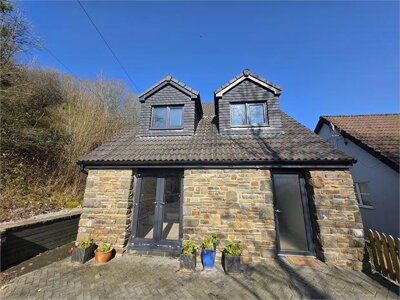
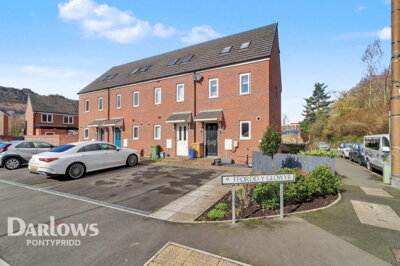
Browse 2 homes new builds in Ynysybwl and Coed-y-cwm from local developer agents.
Three bedroom properties represent a significant portion of the Ynysybwl And Coed Y Cwm housing market, offering space for families with multiple reception rooms and gardens in many cases. Browse detached, semi-detached, and terraced options ranging across new residential developments.
Recent movement in the local market points to a place that has held up well. In Ynysybwl, our data shows house prices rose by 39% against the previous year, and the CF37 3 postcode sector posted a 12.9% increase in property values over the last twelve months. Even with that growth, the area still sits in an accessible bracket, with the overall average at £215,181 for Ynysybwl properties and £215,181 in Coed-y-cwm. There has also been a slight pullback from the 2023 peak of £215,181 in Ynysybwl, by approximately 5%, which may suit buyers looking to get into an improving market.
Most of the homes changing hands here are terraced. In Ynysybwl, terraced properties reached a median sale price of £136,497 from 22 transactions, while semi-detached homes recorded a median of £237,268 across 6 sales. Detached houses are much less common, with only 2 sales at a median of £360,606. Coed-y-cwm comes in a touch stronger for similar stock, with terraced homes at £136,497, semi-detached properties at £237,268, and detached homes at £360,606. Taken together, those figures show why buyers often see good value here compared with nearby towns and cities across South Wales.
Coed-y-cwm has moved differently. House prices there are down 19% year-on-year and now sit 30% below the 2023 peak of £215,181. That gives the two communities a noticeably different feel from a buying point of view, with Coed-y-cwm perhaps suiting value-led purchases while Ynysybwl may appeal more to those looking to buy into established growth. The 30 sales recorded in 2025 across the locality also suggest a market with decent activity across terraced, semi-detached, and detached homes.
There is also an investment angle here, helped by rental demand from commuters heading to nearby towns and into the wider South Wales economic zone. Entry prices remain relatively affordable, which can appeal to landlords looking for yield. For owner-occupiers, the same pricing means lower borrowing needs than in Cardiff and some of the surrounding districts.

The villages of Ynysybwl and Coed-y-cwm sit together in the Cynon Valley within Rhondda Cynon Taf, and they feel very much like a pair. Their combined population was approximately 4,664 at the 2011 Census, small enough to keep a close-knit village character that is harder to find now in many parts of Britain. Steep valley sides, classic Welsh terraced rows climbing the slopes, and the River Cynon winding along the valley floor all shape the setting. Day to day, residents rely on local convenience shops, pubs, and community facilities without always needing to head to a larger centre.
Ynysybwl’s mining past still shows plainly in the way the village looks and works. Much of the area grew through the 19th and early 20th centuries around the coal industry, and many stone and brick terraces from that period remain in place. People moving in often remark on the local pride and the strength of community ties that come with that history. Along roads such as High Street and Commercial Street, you can still see the familiar Welsh valley style, steeply pitched roofs, stone-faced facades, and building methods tied to the industrial era.
Pontypridd, the nearest market town, adds the bigger practical services, retail, supermarkets, healthcare, and entertainment, all a short drive or bus trip to the south. Closer to home, Llanwynno forestry and surrounding woodland give people plenty of scope for walking and cycling, as well as enjoying the South Wales Valleys landscape. Nearby Area of Outstanding Natural Beauty designations also help protect the setting for the longer term.
Life here tends to revolve around familiar local anchors, rugby clubs, chapels, community halls, and events that bring people together across the year. New arrivals often say the same thing, that it is a welcoming place where neighbours know one another and local businesses have served the same families for generations. That sense of belonging is part of the appeal, and it is not something every urban area can offer.

For families moving into Ynysybwl and Coed-y-cwm, primary education is available within the local community. The area comes under the Rhondda Cynon Taf local education authority, which oversees schools across the wider borough. Having primary provision in the village helps reduce longer daily journeys for younger children. We always suggest checking catchment areas and admission rules directly with the local authority, because they can have a real bearing on which property makes sense.
Secondary pupils generally travel to schools in towns such as Pontypridd and Aberdare. Ysgol Gyfun Llanhari is among the nearby secondary schools serving students from the Cynon Valley area, with bus services helping those who live further from the school sites. Rhondda Cynon Taf publishes annual performance information, which can be useful for comparisons, though we still think there is no substitute for visiting in person and speaking to staff about whether a school suits your family.
Some families will want a wider range of education choices, and Pontypridd provides that. The town has several secondary schools, sixth form colleges, and further education options, while the University of South Wales maintains a major campus there as well. Before committing to a purchase, we recommend checking current school performance information, inspection results, and catchment boundaries, as all 3 can shift over time and affect day-to-day family life.
Despite the rural valley setting, the road links are one of the more practical strengths of living in Ynysybwl and Coed-y-cwm. The A4059 is the main route through the Cynon Valley, running north towards Aberdare and south towards Pontypridd and the A470 trunk road. From there, the A470 acts as the principal north-south route through South Wales, connecting former coalfield communities with Cardiff and also carrying on towards the more rural parts of Powys and beyond. For many Cardiff commuters, the drive is approximately 45 minutes to an hour, traffic permitting.
Bus travel is available too. Local providers, including Stagecoach, operate services linking Ynysybwl and Coed-y-cwm with Pontypridd, Aberdare, and other nearby towns, with stops along the A4059 corridor and within the villages themselves. Rhondda Cynon Taf has seen bus infrastructure and service improvements in recent years, which has made living here without a car a more realistic option for some people working locally.
There is no station in the villages themselves, so most people use nearby towns for rail. Pontypridd station gives access to Cardiff Central, Barry, and the Vale of Glamorgan, while Aberdare station is another option for trains to Cardiff and further afield. In practice, plenty of commuters combine a short drive with a rail journey, especially as parking can be limited in larger towns during the busiest periods.
One of the first things we advise is getting a mortgage agreement in principle before you start viewing seriously. Sellers and estate agents usually take that as a sign you are ready to move, which can help when the right home comes up in the Cynon Valley. With average pricing around £215,181, most purchases here will involve mortgage finance, so this step matters.
It is worth spending time with current listings in Ynysybwl and Coed-y-cwm through Homemove before making decisions. That gives you a clearer read on asking prices, the mix of property types, and how long homes usually stay on the market. Ynysybwl’s 39% annual growth suggests firm demand, while Coed-y-cwm’s different pattern may create a different sort of opening depending on your plans.
Once you have shortlisted a few homes, go and see them properly. We suggest looking not only at the building itself, but also at the street, the immediate surroundings, and what is nearby for everyday use. A lot of the local stock dates from the mining era, so surveys are often especially important. It can also help to visit at more than one time of day, just to get a proper feel for noise, traffic, and the general atmosphere.
Before you complete, we strongly recommend a RICS Level 2 Survey. In a place like Ynysybwl, where much of the housing is older and the mining background matters, a survey can flag issues such as subsidence risk, damp, or wider structural concerns. Our inspectors regularly assess Welsh valley homes and are familiar with the construction methods commonly found in this part of the country.
Selecting the right conveyancing solicitor is another key step. They deal with the searches, review the contract papers, and confirm that title to the property is clear before you go ahead with completion. In Rhondda Cynon Taf, a solicitor who already knows the local stock can be especially useful where older homes bring up historic title points.
After the searches are back and your finance is in place, contracts are exchanged and the deposit is paid. Completion then usually follows within days or weeks, at which point you collect the keys. If needed, our team can point you towards local removal firms and help you find tradespeople for any renovation work.
Buying in Ynysybwl and Coed-y-cwm calls for a bit more care than buying on a modern estate. The area’s mining history means buyers should think seriously about subsidence risk and the possible structural effects of old workings below ground. For that reason, we strongly advise a thorough RICS Level 2 Survey on any purchase here. A surveyor will look closely for movement, cracking, and other signs of instability that may tie back to historical mining activity.
The valley setting brings another issue into the picture, flood risk. Homes nearer the River Cynon, or those on the lower parts of the valley, may face greater exposure to river flooding or surface water flooding in periods of heavy rain. Buyers should ask current or previous owners about any known flooding history and check available flood information for the exact address. The Environment Agency and Natural Resources Wales both keep flood risk maps that can help highlight more vulnerable spots.
Because so much of the housing is older, services and thermal performance do not always meet modern expectations. Wiring, plumbing, and insulation may all need attention. Many homes also keep original Victorian or Edwardian details, cast iron fireplaces, cornicing, and timber floors among them, and those features can bring ongoing maintenance with them. A good survey should make clear where upgrades are likely, which helps when you are costing up the purchase.
Across the Cynon Valley, we see some recurring issues when inspecting homes. Poor ventilation often leads to condensation and black mould, electrical systems can be dated and non-compliant with current regulations, and roofs sometimes show the effects of repairs being put off for too long. Homes built before 1960 often have solid walls rather than cavity walls, which changes both how damp behaves and how insulation upgrades need to be approached.
The housing stock in Ynysybwl and Coed-y-cwm mostly dates back to the late 19th and early 20th centuries, when the villages expanded around the coal industry. In simple terms, that means a large proportion of homes are now well over 100 years old and prone to the kinds of defects often seen in historic construction. Our inspectors regularly come across rising damp, particularly where there is no effective damp-proof course, or where an original one has failed, allowing moisture to rise through solid walls. It is especially common in houses that have been altered unsympathetically or had original features removed.
Roofs are another regular talking point in our surveys here. The steeply pitched coverings typical of Welsh valley terraces can suffer from slipped or missing tiles, failing mortar to verges and ridges, and flashings that have deteriorated after years in the South Wales weather. On many of these older homes, timber soffits and fascias also show rot, often because blocked or damaged gutters have let water spill repeatedly onto the wood.
Any sign of movement needs to be considered carefully, particularly in an area with a mining legacy. Large-scale mining subsidence is relatively rare, but old mine shafts, shallow workings, or other underground excavations can still lead to movement that shows up as wall cracks, doors and windows sticking, or uneven floors. Our surveyors apply established assessment criteria to judge the significance of what they find and to advise whether further investigation or a specialist opinion is needed.
In houses of this age, electrical and plumbing installations are often near the top of the upgrade list. Older fuse boards may not provide the circuit protection expected today, and wiring installed before modern regulations can create a fire risk. Water services can be just as dated, with lead or iron pipework from the Victorian era sometimes corroded or contaminated after long use. We usually suggest allowing for these works in your budget from the outset.
The purchase price is only part of the picture in Ynysybwl and Coed-y-cwm. In Wales, stamp duty land tax follows separate Welsh legislation, and rates apply from the first pound on purchases above £225,000. Since the average Ynysybwl price is approximately £215,181, many buyers of standard terraced homes will stay below that threshold altogether. Welsh land transaction tax is more likely to come into play for higher-value semi-detached or detached properties.
There are other buying costs to plan for as well. Solicitor conveyancing fees often start from around £499 on a straightforward transaction, though more complex purchases can cost more. A RICS Level 2 Survey starts from approximately £350 and is strongly recommended here because of the age of the stock and the possibility of mining-related issues. Costs rise for larger houses or for inspections that need to go into more detail. On top of that, buyers should allow for removals, mortgage arrangement fees, and any repairs or renovation.
First-time buyers in Wales can get extra relief up to £300,000, with reduced rates between £300,001 and £450,000. In a market at these price levels, many first-time buyers purchasing terraced homes in Ynysybwl or Coed-y-cwm will have no land transaction tax to pay. Buyers who are not first-time purchasers are still helped by the fact that only the priciest homes locally tend to trigger notable Welsh tax charges. We always advise checking the latest position with a solicitor or tax adviser, since thresholds can change from year to year.
The current averages remain fairly modest by wider regional standards. Ynysybwl sits at approximately £215,181, and Coed-y-cwm is slightly higher at £215,181. Terraced homes make up most of the market, with median prices of £136,497 in Ynysybwl and £136,497 in Coed-y-cwm from 2025 sales data. Semi-detached houses sit at £237,268 to £237,268 depending on which community you are looking at, while detached properties come in between £360,606 and £360,606. In Ynysybwl, prices are up 39% year-on-year, which points to a market that has been appreciating and may hold long-term appeal for both owners and investors.
Administrative matters here fall under Rhondda Cynon Taf County Borough Council. Council tax bands run from A to H, and many of the terraced homes in these valley villages will usually sit within bands A to C because of their lower valuations. The exact band always depends on the individual property, and buyers can confirm it through the Welsh Revenue Authority website or with the local council. Band A homes in Rhondda Cynon Taf currently attract the lowest council tax rates in Wales, which can make the area particularly appealing to buyers trying to keep monthly outgoings down.
Schooling is one of the practical checks families should make early on. There are local primary schools within the community, while secondary education is generally provided in Pontypridd, Aberdare, and other nearby towns. The Rhondda Cynon Taf local education authority is the best place to check the latest on performance, catchment rules, and admissions, all of which can change between academic years and directly affect who can attend what. Pontypridd also adds further education choices, including colleges and the University of South Wales campus. For buyers with children, careful research before committing to a property is time well spent.
Getting around is fairly straightforward for a valley location. Local bus services connect Ynysybwl and Coed-y-cwm with Pontypridd, Aberdare, and nearby districts, and Stagecoach is among the operators running regular routes along the A4059 corridor. That road is the main link through the Cynon Valley and ties into the A470 trunk road for journeys towards Cardiff and further afield. By car, Cardiff is usually around 45 minutes to an hour away, depending on traffic on the A470. For rail travel, most residents use nearby stations, with Pontypridd station offering services to Cardiff Central, Barry, and the Vale of Glamorgan.
Ynysybwl has posted notably strong price growth. Values are up 39% year-on-year, with the CF37 3 postcode sector also rising by 12.9% over the latest twelve-month period. Compared with Cardiff and nearby areas, the lower entry point can make this market attractive to first-time buyers and investors looking for affordable homes with room for growth. Rental demand is supported by people commuting to surrounding towns and across the broader South Wales economic zone. The mining heritage and valley setting do mean some properties need maintenance spending, but that is part of why purchase prices remain accessible for buyers who may be priced out elsewhere.
Wales has its own system for stamp duty land tax, separate from the wider UK approach. On a standard residential purchase, the rates are 0% up to £225,000, then 6% on the portion from £225,001 to £400,000, and 7.5% on anything above £400,000. First-time buyers in Wales receive relief on properties up to £300,000, with reduced rates applying between £
The valley floor and lower slopes can bring flood considerations into play in Ynysybwl and Coed-y-cwm. Homes close to the River Cynon, in particular, may face a higher risk, and heavy rainfall can also lead to surface water flooding in lower-lying spots. We recommend checking the Natural Resources Wales flood risk maps for the exact address, asking current or previous owners whether there has been any past flooding, and confirming before completion that buildings insurance will cover flood risk.
For any purchase in Ynysybwl or Coed-y-cwm, we would strongly suggest a RICS Level 2 Survey. The historical coal mining context matters here, because former underground workings can sometimes lead to ground movement that affects foundations and the wider structure. A professional survey looks for cracking, movement, and similar warning signs, and it helps show whether anything points to mining-related problems that need further investigation or remedial work.
From £350
A detailed survey for conventional properties
From £450
Comprehensive structural survey for older properties
From £80
Energy performance certificate
From £499
Solicitors to handle your purchase
From 4.5% APR
Competitive mortgage rates available
Properties New Builds In London

Properties New Builds In Plymouth

Properties New Builds In Liverpool

Properties New Builds In Glasgow

Properties New Builds In Sheffield

Properties New Builds In Edinburgh

Properties New Builds In Coventry

Properties New Builds In Bradford

Properties New Builds In Manchester

Properties New Builds In Birmingham

Properties New Builds In Bristol

Properties New Builds In Oxford

Properties New Builds In Leicester

Properties New Builds In Newcastle

Properties New Builds In Leeds

Properties New Builds In Southampton

Properties New Builds In Cardiff

Properties New Builds In Nottingham

Properties New Builds In Norwich

Properties New Builds In Brighton

Properties New Builds In Derby

Properties New Builds In Portsmouth

Properties New Builds In Northampton

Properties New Builds In Milton Keynes

Properties New Builds In Bournemouth

Properties New Builds In Bolton

Properties New Builds In Swansea

Properties New Builds In Swindon

Properties New Builds In Peterborough

Properties New Builds In Wolverhampton

Enter your details to see if this property is within your budget.
Loans, cards, car finance
Estimated property budget
Borrowing + deposit
You could borrow between
Typical borrowing
Monthly repayment
Est. at 4.5%
Loan-to-value
This is an estimate only. Your actual budget may vary depending on interest rates, credit history, and personal circumstances. For an accurate affordability assessment, speak to one of our free mortgage advisors.
This calculator provides estimates for illustrative purposes only and does not constitute financial advice. Your home may be repossessed if you do not keep up repayments on your mortgage. Estimates based on 4.5% interest rate, repayment mortgage. Actual rates depend on your circumstances.
Homemove is a trading name of HM Haus Group Ltd (Company No. 13873779, registered in England & Wales). Homemove Mortgages Ltd (Company No. 15947693) is an Appointed Representative of TMG Direct Limited, trading as TMG Mortgage Network, which is authorised and regulated by the Financial Conduct Authority (FRN 786245). Homemove Mortgages Ltd is entered on the FCA Register as an Appointed Representative (FRN 1022429). You can check registrations at NewRegister or by calling 0800 111 6768.

We use cookies to show you personalised content and improve your experience of our website. Find out more in our Privacy policy and Cookie policy.