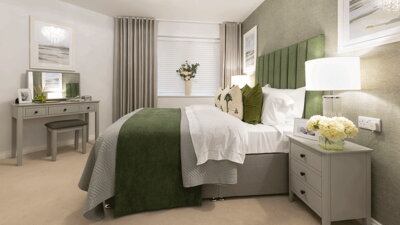
Browse 1 home new builds in Haverhill, West Suffolk from local developer agents.
The 2 bed flat sector typically includes two separate bedrooms, dedicated living areas, and bathroom facilities. Properties in Haverhill span purpose-built blocks, converted period houses, and modern apartment complexes on various floors.
£245k
3
0
297
Source: home.co.uk
Showing 3 results for 2 Bedroom Flats new builds in Haverhill, West Suffolk. The median asking price is £245,000.
Source: home.co.uk
Flat
3 listings
Avg £213,332
Source: home.co.uk
Source: home.co.uk
Haverhill still offers real value beside neighbouring Cambridge, where average prices regularly exceed £450,000. Current figures put detached homes at £440,000, semi-detached at £290,000, terraced houses at £230,000, and flats at £150,000. Over the last twelve months, every property type has edged up, with semi-detached homes leading at 1.7%, then detached properties at 1.1%, terraced homes at 0.9%, and flats at 0.7%. That kind of measured growth points to a town that is becoming more sought after, both for commuting and for buyers who have been priced out of Cambridgeshire’s bigger centres.
Three major housing sites are currently shaping the new build market across Haverhill. The Views on Hanley Road, by Taylor Wimpey, offers 2, 3, and 4-bedroom homes priced from £299,995 to £449,995. The Sycamores on Chalkstone Way, built by Persimmon Homes, runs from £275,000 to £425,000. Hanley Grange, also on Hanley Road and developed by Bellway, sits in the £290,000 to £450,000 range. Together, they have widened choice on the eastern side of town while keeping Clements Primary Academy and Meadow First School within easy reach.
Haverhill’s housing stock tells the story of a market town that has grown into a modern residential base over recent decades. Census data shows semi-detached homes make up 34.2% of all properties, followed by terraced housing at 29.8%, detached houses at 22.1%, and flats and maisonettes at 13.9%. Age data also points to a strong post-war pattern, with around 30-35% of homes built between 1945 and 1980, and another 30-40% dating from 1980 onwards. Buyers can still find older places with character, but there are plenty of newer homes with contemporary layouts and better energy performance too.
Sales activity remains healthy, with 369 property transactions recorded over the past twelve months. That level of movement suggests steady buyer demand, helped by the town’s commutable position and its lower price point compared with surrounding areas. Sellers do have buyers, but competitive pricing matters, especially with new build homes sitting at similar levels. We keep our listings updated so buyers can see what is available across Haverhill’s different streets and property types.
At the centre of Haverhill, the Town Hall anchors a conservation area that protects Georgian and Victorian buildings along High Street and Queen Street. The twice-weekly market still gives the town centre a proper market town feel every Tuesday and Saturday, and that matters. Local shops, cafes, and independent businesses line the main streets, while annual fixtures such as the Haverhill Summer Festival and the Christmas lights switch-on bring in visitors from nearby villages. The conservation area also covers the Grade II listed Town Hall and a number of 18th and 19th century commercial premises.
Green space is easy to come by, with several parks and open areas spread across the residential parts of town. Haverhill also has access to the Suffolk countryside, where footpaths and bridleways give walkers and cyclists routes out into the rural landscape. Families benefit from that, along with youth facilities and community groups that make the town feel lived in rather than just built up. There is a leisure centre too, complete with swimming facilities and sports pitches. With a population of approximately 27,041 across 11,200 households, the town manages to keep a sense of community without losing everyday convenience.
Industry and commerce have changed the local economy quite a bit, with business areas now home to employers such as Sanofi and Sigma-Aldrich, part of Merck KGaA. Those companies bring skilled work in pharmaceuticals and manufacturing. Haverhill also acts as a service centre for neighbouring rural communities, so retail, education, and healthcare all add to the job market. That mix supports housing demand from people who want to live near work, while the town’s place close to the A11 corridor gives flexibility to anyone commuting further afield.
Day-to-day living is well supported by the local infrastructure, with a community hospital and several GP surgeries serving residents. In recent years, investment in the town centre has improved the public realm and parking provision, which has made shopping and visits a little easier. Libraries, community centres, and places of worship also play their part in serving the town’s varied needs. For buyers, that blend of practical amenities, local pride, and steady investment gives Haverhill a solid feel for long-term living.

Children in Haverhill can move through education from nursery to further education without having to travel far, and the town’s primary schools are spread across residential areas to keep journeys short. Several schools serve different catchments, which gives parents some choice depending on location and preference. Primary provision includes Clements Primary Academy on Chapman Close, St Felix Middle School, which sits within the local three-tier system, and Meadow First School, among others serving different neighbourhoods. Parents should check current catchment boundaries directly with Suffolk County Council, because those lines can affect which school a specific address falls into.
Secondary schooling sits within Haverhill’s three-tier setup, with middle schools such as Holbrook Academy and Samuel Ward Academy taking pupils from Year 5 through Year 9. After that, students move on to upper schools including Saffron Walden County High School, which draws from a wider area that includes Haverhill, or comparable options. We always suggest checking current Ofsted ratings and looking at school performance alongside catchment areas before buying, since school quality can shape both family routines and property values in the most sought-after zones.
Sixth form study can continue locally, so students do not have to head straight to a larger town for A-levels or vocational qualifications. Further education is also available beyond Haverhill, with some students choosing to travel to Cambridge, Bury St Edmunds, or colleges such as Cambridge Regional College and West Suffolk College for specialist courses. That spread of provision across all age groups has helped make the town attractive to families, since it reduces the pressure to move when children reach secondary school and supports values in popular catchment areas.
For families planning a purchase, catchment areas matter a great deal because they can shape both the school run and the longer-term value of a home. Properties in well-regarded catchments often sell faster and attract stronger prices, so this can be a deciding factor. Our property listings include location details to help families identify homes in preferred school zones, and we suggest visiting schools in person before making an offer, so you can judge whether they suit your family’s needs.
At around 17 miles from Cambridge, Haverhill is a practical choice for commuters looking for more affordable housing than the city itself offers. The A1017 links the town to the A11 trunk road, which opens a direct route to Cambridge and, beyond that, the M11 for London and Stansted Airport. That road connection has played a big part in Haverhill’s growth as a commuter base, while regular bus services between Haverhill and Cambridge give an alternative for those who prefer public transport. The A1307 offers another route towards Saffron Walden and beyond, with useful links for people working towards Newmarket and the A14 corridor.
Rail travel is available from nearby Audley End and Dullingham, both of which connect to Cambridge and London Liverpool Street. Audley End is approximately 20 miles from Haverhill and offers direct trains to London Liverpool Street, with journey times usually around 60-70 minutes. Dullingham provides similar links and sits on the Ipswich to Cambridge line. Both stations have car parking, so Haverhill residents can drive there without much trouble. For those commuting to Cambridge, the car journey typically takes around 35-40 minutes outside peak hours.
Bus services run throughout Haverhill and link the town with nearby villages including Steeple Bumpstead, Helions Bumpstead, and Kedington. They are useful for local workers and for anyone needing services in nearby towns such as Saffron Walden and Clare. Drivers have seen improvements too, with parking provision in the town centre upgraded in recent years and public car parks available for shoppers and visitors. The internal road network handles local traffic well, and the town’s position near the main routes means most residential areas avoid the worst of through-traffic.
Cycling has become easier in Haverhill, with safer routes now making short journeys to schools, shops, and workplaces more practical. The gently flat Suffolk landscape also suits cyclists, and local routes link residential streets to the town centre and nearby villages. For commuters who work flexibly, the combination of rail links and road access to Cambridge makes the town especially workable for people who travel in only a few days a week rather than every day.
Before we book viewings, it is sensible to get a mortgage agreement in principle from a lender. That gives estate agents proof of buying power and puts us in a stronger position when offers go in. Haverhill draws interest from local buyers and commuters from Cambridge alike, so being ready financially matters in a market where well-priced homes can attract multiple offers.
We would suggest exploring our Haverhill listings with price trends and comparable sales in mind across the different property types. With 369 properties currently available and annual price growth of 1.2%, a good grasp of local values helps buyers spot sensible opportunities. It also pays to compare older homes in the town centre conservation area with the newer developments on the edge of town.
Arrange viewings through estate agents once you have a shortlist that fits your criteria. It helps to look at homes across several price bands and property ages, because that shows what your budget actually buys, from flats above shops on High Street to detached family houses on new build estates. We can point you towards local estate agents in Haverhill so viewings can be organised efficiently.
When an offer has been accepted, a RICS Level 2 Survey should be arranged before completion. In Haverhill, these usually cost £400-700 depending on the size of the property. The survey can pick up defects that are common in local housing stock, including problems linked to clay soils, specifically Glacial Till with moderate to high shrink-swell risk, older building methods, and the extra issues that can come with period properties in the conservation area.
A solicitor should then be instructed to deal with the legal work involved in the purchase. They will carry out local authority, drainage and water, and environmental searches that are specific to the Haverhill area. Because some lower-lying parts of town have surface water flood risk, an environmental search is especially useful for checking any flood history or risk at the address you are buying.
Once the survey results and legal checks are satisfactory, contracts are exchanged and the deposit is paid. Completion usually follows within weeks, at which point the keys are handed over and ownership of the new Haverhill home passes across. Your solicitor will work with the seller’s legal team to keep the transaction moving smoothly through to completion and to register the ownership with HM Land Registry.
Haverhill and the wider West Suffolk area sit on geology that brings its own issues for buyers, and it is not the same as many other parts of Suffolk. The underlying Chalk bedrock, together with superficial Glacial Till deposits, means clay soils are common in many locations, bringing a moderate to high shrink-swell risk. Homes with shallow foundations, or those close to substantial trees, may be vulnerable to subsidence or heave, especially in drought or heavy rain when clay contracts or expands. A proper survey can pick up structural movement, crack patterns, or foundation concerns before purchase goes any further.
Some low-lying parts of Haverhill are affected by surface water flooding, particularly where heavy rainfall overwhelms drainage systems. The River Stour brings limited fluvial flood risk to the town centre itself, but standing water can still affect basements, gardens, and ground floor accommodation on certain streets, including some properties near the town’s drainage channels. It is wise to review Environment Agency flood maps and talk to neighbours and estate agents, because local knowledge can add useful context for any property you are considering.
Within the Haverhill Conservation Area, which includes parts of the town centre such as High Street, Queen Street, and the surrounding historic lanes, planning controls are tighter than in many other places. These rules protect the external look of buildings and limit permitted development rights for extensions, dormer windows, and similar changes. Exterior materials and colours may need approval from West Suffolk Council planning department. Buyers of listed buildings should remember that alterations also need Listed Building Consent, and specialist surveys are sensible when checking original brickwork, timber framing, and period features.
Older Haverhill homes often need a careful eye before purchase. Rising damp is common in properties built before modern damp-proof courses were standard, especially where solid floors are used rather than suspended timber. Roof problems such as slipped tiles, failing leadwork on valleys and junctions, and worn mortar are frequently found in homes over 50 years old, which make up around 50-60% of the local stock. Timber issues, including wet rot and woodworm, can affect roof structures, floor joists, and window frames where moisture has got in or the timber was never properly treated. We recommend a RICS Level 2 Survey to identify these matters before purchase, or a more detailed RICS Level 3 Survey for listed buildings and non-standard construction.
Based on February 2026 data, the current average property price in Haverhill is £290,294. Detached homes average £440,000, semi-detached properties £290,000, terraced houses £230,000, and flats £150,000. Prices have moved up by 1.2% over the past twelve months, with semi-detached homes showing the strongest growth at 1.7%. That leaves Haverhill well below nearby Cambridge, where average prices regularly exceed £450,000, while still keeping the town close to major employment centres and strong transport links via the A11 corridor.
Haverhill sits within West Suffolk Council’s area, and most homes fall into Bands A through D, which reflects values up to £120,000. Band A runs to £30,000, Band B covers £30,001 to £52,000, Band C spans £52,001 to £68,000, and Band D covers £68,001 to £88,000. The correct band for any property can be checked through the Valuation Office Agency website using the address. Council tax bills are issued each year by West Suffolk Council, and current rates should be checked directly, as they are set annually.
Haverhill uses a three-tier education system, with first schools, middle schools, and upper schools covering different age groups. Primary provision includes Clements Primary Academy, Meadow First School, and Several Schools Federation schools serving different neighbourhoods. Middle schools such as Holbrook Academy and Samuel Ward Academy take pupils from Year 5 through Year 9, before they move on to upper school sixth forms or further education colleges. Parents should check current Ofsted ratings and catchment boundaries directly with schools and Suffolk County Council, since both can change and have a big effect on which homes suit a family best.
Bus services run regularly between Haverhill and Cambridge, as well as villages including Kedington, Steeple Bumpstead, and Clare. Rail access comes via Audley End station, approximately 20 miles away, which offers direct trains to Cambridge and London Liverpool Street, with journey times of 60-70 minutes to the capital. Dullingham station on the Ipswich-Cambridge line adds another rail option. By road, the A1017 links straight to the A11 and M11, so car travel is fairly straightforward at approximately 17 miles to Cambridge, with good routes north towards Norwich via the A14 corridor.
For landlords and capital growth investors, Haverhill throws up several points of interest. Property values have risen steadily at 1.2% annually, and the town is still much more affordable than Cambridge, which suggests demand should continue from buyers priced out of the Cambridgeshire market. Strong commuting links through the A11 corridor bring in people working in Cambridge or London who cannot afford to live nearer those jobs. Local employers such as Sanofi and Sigma-Aldrich support employment and housing need in pharmaceuticals, while new build sites have widened supply without really easing demand from commuters and families. In the town centre conservation area, properties needing renovation may offer useful value-add potential for investors willing to carry out sympathetic improvements.
For standard purchases in England, stamp duty land tax works at 0% on the first £250,000 of property value, 5% from £250,001 to £925,000, 10% from £925,001 to £1.5 million, and 12% above £1.5 million. First-time buyers get relief on the first £425,000, where the rate is 0%, with 5% applying between £425,001 and £625,000. On a typical Haverhill home priced at £290,294, most non-first-time buyers would pay no stamp duty on the first £250,000 and 5% on the remaining £40,294, which comes to roughly £2,015. First-time buyers paying the average Haverhill price would pay no stamp duty at all, thanks to the higher threshold.
Because around 50-60% of Haverhill’s housing stock is over 50 years old, several common problems need to be checked during inspections. Rising damp often affects older homes without modern damp-proof courses, especially where solid ground floors are present. Roof defects such as slipped or broken tiles, failing lead flashing, and worn pointing deserve close attention. Homes on clay soils may face subsidence risk because of the moderate to high shrink-swell potential of local Glacial Till deposits, particularly near large trees or where foundations are shallow. Electrical systems in pre-1980s properties often need upgrading because the original wiring may no longer meet current standards. Plumbing in older houses may still rely on galvanised steel or lead pipes that need replacing. We strongly advise a RICS Level 2 Survey to identify these issues before purchase, with a more comprehensive RICS Level 3 Survey for listed buildings or non-standard construction.
Three major new build sites are currently selling homes in Haverhill from well-known developers. The Views on Hanley Road, by Taylor Wimpey, offers 2, 3, and 4-bedroom homes from £299,995 to £449,995. The Sycamores on Chalkstone Way, built by Persimmon Homes, is priced from £275,000 to £425,000. Hanley Grange on Hanley Road, developed by Bellway, ranges from £290,000 to £450,000. All three schemes sit on the eastern side of town, with decent access to local schools, shops, and the A1017. New builds usually bring warranty cover and modern energy efficiency, although they can sit above similar older homes in price.
Getting to grips with the full cost of buying in Haverhill helps with budgeting and keeps unwanted surprises out of the process. Alongside the property price, buyers need to allow for stamp duty land tax, legal fees, survey costs, and moving expenses. On a typical Haverhill home at £290,294, most non-first-time buyers would pay no stamp duty on the first £250,000 and 5% on the remaining £40,294, which works out at around £2,015. Those costs should sit alongside the deposit and mortgage when working out what the purchase really costs.
First-time buyers buying homes up to £425,000 qualify for relief on the whole purchase price under the current rules, so stamp duty is removed entirely for most first-time purchases in Haverhill. For first-time buyers at between £425,001 and £625,000, stamp duty is charged at 5% on the amount above £425,000. As the average Haverhill property is £290,294, which is well below both thresholds, many first-time buyers in the town will pay no stamp duty at all, making it a strong option for people taking their first step onto the property ladder.
There are other buying costs to keep in mind too, including survey fees for a RICS Level 2 Survey, which usually come to £400-700 for Haverhill properties depending on size and value. A 3-bedroom semi-detached home would typically cost about £450-600 for a Level 2 Survey. Conveyancing fees generally start from £499 for standard transactions, but they rise for leasehold properties, homes in the conservation area, or cases that need extra legal work. Removal costs vary with distance and the amount being moved. Budgeting for these costs as well as your deposit and mortgage helps the purchase run more smoothly at completion.

From £400
A detailed condition check, focused on defects common to local housing stock, including damp, subsidence risk, and roof problems
From £550
A thorough building survey, often advised for older properties, listed buildings, and non-standard construction
From £60
An Energy Performance Certificate, which every property sale needs in order to show energy efficiency
From £499
Solicitors who handle the legal transfer of ownership, including searches and contracts
From 4.5%
Whole-of-market mortgage brokers who can search for the best deal for your purchase
Properties New Builds In London

Properties New Builds In Plymouth

Properties New Builds In Liverpool

Properties New Builds In Glasgow

Properties New Builds In Sheffield

Properties New Builds In Edinburgh

Properties New Builds In Coventry

Properties New Builds In Bradford

Properties New Builds In Manchester

Properties New Builds In Birmingham

Properties New Builds In Bristol

Properties New Builds In Oxford

Properties New Builds In Leicester

Properties New Builds In Newcastle

Properties New Builds In Leeds

Properties New Builds In Southampton

Properties New Builds In Cardiff

Properties New Builds In Nottingham

Properties New Builds In Norwich

Properties New Builds In Brighton

Properties New Builds In Derby

Properties New Builds In Portsmouth

Properties New Builds In Northampton

Properties New Builds In Milton Keynes

Properties New Builds In Bournemouth

Properties New Builds In Bolton

Properties New Builds In Swansea

Properties New Builds In Swindon

Properties New Builds In Peterborough

Properties New Builds In Wolverhampton

Enter your details to see if this property is within your budget.
Loans, cards, car finance
Estimated property budget
Borrowing + deposit
You could borrow between
Typical borrowing
Monthly repayment
Est. at 4.5%
Loan-to-value
This is an estimate only. Your actual budget may vary depending on interest rates, credit history, and personal circumstances. For an accurate affordability assessment, speak to one of our free mortgage advisors.
This calculator provides estimates for illustrative purposes only and does not constitute financial advice. Your home may be repossessed if you do not keep up repayments on your mortgage. Estimates based on 4.5% interest rate, repayment mortgage. Actual rates depend on your circumstances.
Homemove is a trading name of HM Haus Group Ltd (Company No. 13873779, registered in England & Wales). Homemove Mortgages Ltd (Company No. 15947693) is an Appointed Representative of TMG Direct Limited, trading as TMG Mortgage Network, which is authorised and regulated by the Financial Conduct Authority (FRN 786245). Homemove Mortgages Ltd is entered on the FCA Register as an Appointed Representative (FRN 1022429). You can check registrations at NewRegister or by calling 0800 111 6768.

We use cookies to show you personalised content and improve your experience of our website. Find out more in our Privacy policy and Cookie policy.